



Are you in the t-shirt business? Like to know how t-shirts are printed? In this post, I will show you the t-shirt printing process.
Mostly, T-shirts are printed after cutting and printing is done of panels. But yes, t-shirts can be printed after stitching the t-shirt.
In a t-shirt panel, printing can be done on any part or number of parts of the t-shirt. Like, in front, back, back yoke, moon patch, and sleeves, etc. It all depends on the t-shirt design and buyer specification.
Let’s say we are going to print a design (graphics) on the cut panels. For that, we need to follow these steps. These steps are shown in the context of export orders.
1. Check the position of the print on the T-shirt.
Read the tech pack for print position and color combination. Check buyer’s latest comments on the printing in the sample approval. Provide all required information to the cutter like the print position. If required pattern master should also be involved. In the pattern, you can add the print position as well.
2. Cut fix panels or block
Depending on the print position on the panels and printer’s requirement, either cut fix panes or cut the panel in the block. If it is in the edge of the panels, or if you need to match prints between panels (front and back or sleeve and fronts) you have to cut fabrics in a block instead of fix cutting.
3. Define location for ply numbering.
Don’t put a numbering sticker on the place where printing is to be done.
4. Send cutting to printing house:
When sending cuttings (cut panels) to the printing house, sent a pattern for print locations. If your design has different print locations for different garment sizes, prepare a size-wise pattern for print location and send it. In the big factories, normally, the store handles sending cut panels to the printing vendor.
5. Print and color approvals:
At this stage, you will already have an approved print strike-off from the buyer.
Send that approved swatch to the printing factory for color reference. Up to this part is done by the garment factory.
The printing house needs to do all preparations like developing design, preparing screen, and color development. As per the reference color and shade, the printing house makes the color.
When the print house received the cut panels, they verify the received quantity and keep a record for the same.
6. Printing:
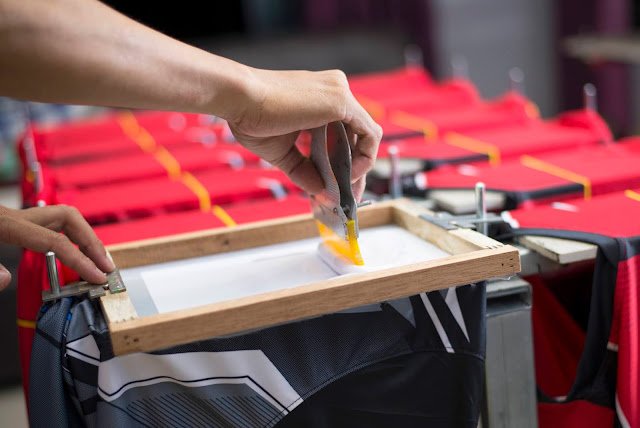
Once printers get approval for the color and design (artwork and placement), they start bulk printing. Let’s consider printing will be done using a screen and printing will be done on a flat table. The printer (printing house) does the marking of panel position on the printing table. They lay each t-shirt cut panel on the table following the position. Then they place the screen (having the image /print motif) on the top of the cut panel. Pour the liquid color on the screen and manually spread the color and squeeze it.
In case there are multiple colors in a print design, different screens are prepared for each color. The same method is followed for each color.
7. Dry the printed panels:
Printed panels are dried in the open air. Normally, drying is done by using heat or hanging the printed panels on a rope. Once the print color is dried, all printed panels are passed through a curing machine.
8. Curing:
To fix the color printed panels are passed inside the curing machine.
9. Bundling:
9. Bundling:
After curing printed panels are sorted by size and fabric color. Then sorted panels are bundled again following ply numbering. Now the printing process is complete from the printing house.
10. Receive the printed T-shirt panel back.
10. Receive the printed T-shirt panel back.
Once printing is over, the print house sends back the printed panels to the garment factory.
11. Check quality and quantity of printed panels:
On receiving the printed panels from a vendor first fount number of pieces received. Later check print quality prior to bundling and sending to stitching.
In this article, you show the process followed for printing t-shirt in the panel form. Printing on the cut panel is easier compared to printing after stitching the t-shirt. In another article, we will discuss the printing of t-shirts in the garment stage.
Related Article: